
Dr. Sarah Cooper, Director of People Services from Bradford College came to the Breakfast Club in July of 2021 to share their experience of implementing the Investors in Diversity accreditation framework to help focus and structure work the work they were doing across the EDI agenda.
The diverse demographic of Bradford as a city and the College itself provided a compelling reason to ensure that learners and students experienced a workplace and study culture that was truly inclusive. Also, as a City of Sanctuary, the region receives round 13% of the UK’s Asylum Seekers and migration data shows Bradford to be one of four locations to receive the highest proportion of these individuals. The College has a large Adult and Community department supporting a diverse group of learners, including some of the most vulnerable communities of Bradford including refugees and asylum seekers. Teaching of these learners is at the college and at over 40 venues across Bradford. With between 15,000 and 20,000 students, they identified that the overall student and staff college staff population was around two thirds white and one third BAME, however, in their 16–18-year-old demographic comprising around 3,500 learners, the ratio switched, with two thirds being from BAME background and just one third White. Ensuring that best practice EDI principles are embedded is an important feature of their college identity and community.
In January 2021 they decided to partner with the National Centre for Diversity (NCFD) to bring structure and challenge to help strengthen their work around EDI.
The National Centre for Diversity has 15 years’ experience of building exclusive organisations and covers the breadth of the UK. They work with over 600 strategic EDI partners across all sectors, facilitating benchmarking in order to be able to compare how you’re doing. They also provided a dedicated account manager for advice and guidance and support throughout the whole process.
The IiD process started with a survey conducted by the NCFD across the Colleges stakeholders around the perception of EDI across the organisation. Conducted with students, staff and external stakeholders, over 600 took part in the survey. The NCFD then analysed and provided feedback and recommendations on the findings.
A launch meeting took place in the college with all key stakeholders together with the EDI College’s EDI Committee which oversaw the governance of the project. This was a half day event facilitated by the NCFED, during which feedback on the survey was presented and a first draft action plan was developed. Heads of Department attended, from across the functional areas as well as the curriculum areas.
It was clear that there was a lot of different EDI work taking place across the whole college, and they knew that they were doing lots of really good stuff, but the feedback from the survey made them realise how fragmented their efforts were and how pulling it all together under the action plan, broken down into specific themes would bring a more cohesive and joined up approach, and ultimately have a greater impact on cultural change.
The NCFD has undertaken extensive research into what makes workplace culture inclusive and consequently have developed the FREDIE framework to underpin the Investors in Diversity award.
The foundation of the IiD framework are the FREDIE principles and the EDI action plan was based on these five core components of an inclusive workplace culture:
- Fairness for all is a reality
- Respect for all is the norm
- Equality of Opportunity is embedded
- Diverse employees feel that they belong
- Inclusion is widely understood, all colleagues are committed to inclusive behaviours and leaders connect the link between an inclusive culture and business performance
- Engaged – positive emotional attachment between colleagues, their work, managers, and leaders – where everyone lives the values and goals of the organisation.
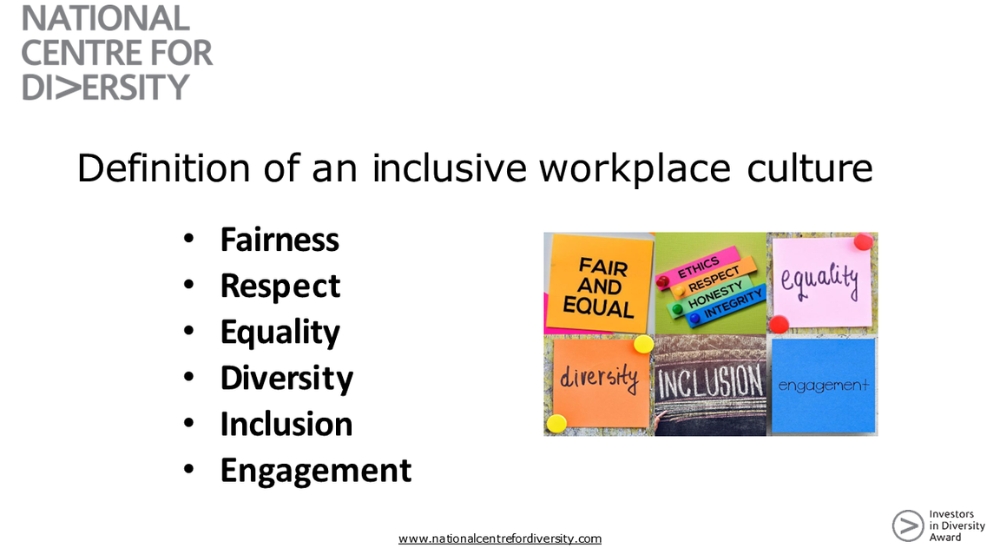
The ethos is if you get the FREDIE right – you get the culture right and if the culture is right you can then deliver on your strategy. It all about helping to create and develop a truly inclusive culture.
Critical Success Factors
To help focus the college on the journey ahead, the NCFD shared the three critical factors that are crucial to success.
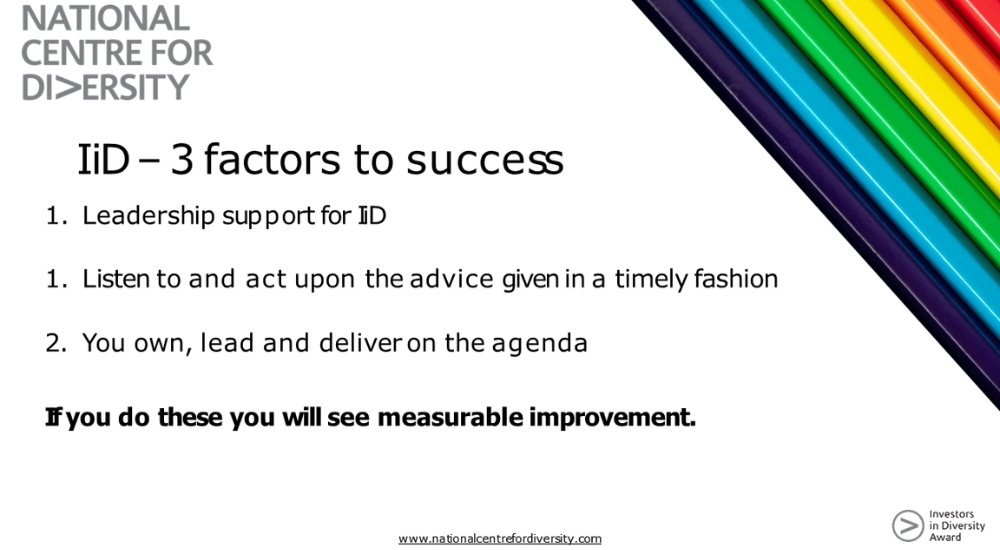
Leadership Support
For this initiative, Craig Tupling Vice Principal for Quality and Student Experience led the project, as Chair of the EDI Committee, and Sarah Cooper, Director of People Services led on the people agenda. Heads of Department, the Head of Quality and Head of Student Services and Head of HR were also involved.
The CEO for Bradford College, Chris Webb, was also very involved in a range of EDI networks including the Black FE Leadership Group, and Co-Lab and have also been involved in research with those groups.
In addition, they reinforced their leadership commitment to EDI through creating a new senior leadership EDI role to help ensure a sustainable approach beyond the actual IiP assessment process. Alina Khan, Vice Principal EDI, joined the college executive in this role in early 2022.
The Process
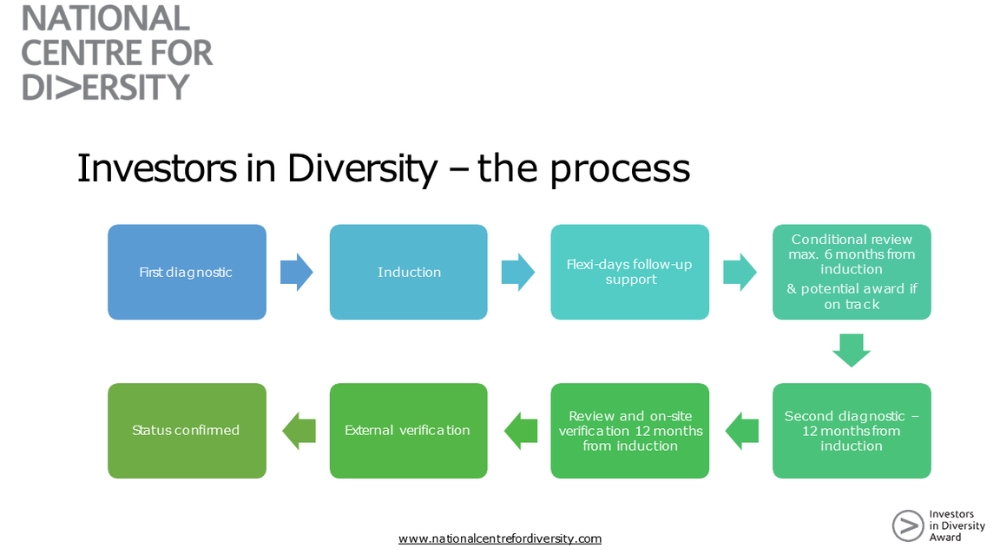
Essentially the process itself one of continuous assessment, improvement and review
Throughout the process they had access to support from the IiD team, and they also attended at regular EDI committee meeting to help and advise on the action plan.
The process concludes with a final assessment and audit.
NDFD provided a wealth of support and helpful resources.
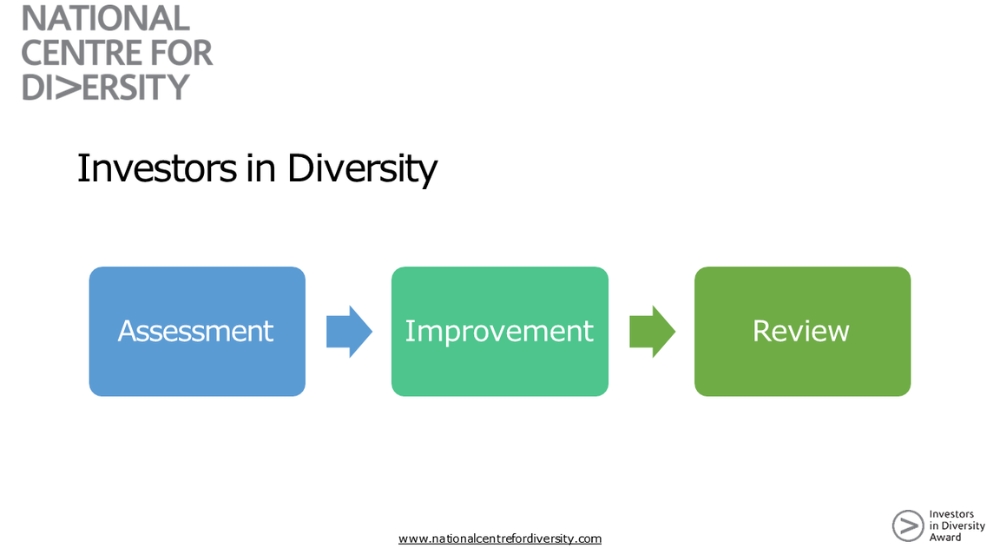
Sarah likened it a bit to preparing for an OFSTED inspection, you have to demonstrate that you’ve done, what you said you would do and have the evidence to show.
Feedback from the Survey
The survey take up was healthy with 245 employees completing the survey, 345 students completing it and 57 external stakeholders taking part.
The NCFD provided analysis and feedback of the findings of the survey.
At the time of the survey, their strengths were considered to be: –
- 99% plus, of respondents understood what FREDIE means
- 68% said yes their team or department discussed the advantages of diversity within the organisation
- 83% colleagues & 82% managers – respondents feel take FREDIE seriously in the way that they behave
- 97% colleagues & managers – respondents think are accepting of people from diverse backgrounds
- 95% of respondents have thought about how inclusive their behaviour is towards people who have a different personality to their own
- 87% responded yes know what unconscious bias is
- 85% responded have had diversity training in the last 2 years
- 80 – Neuro-equality,
- 74 Unconscious Bias,
- 72 MH/Promoting good MH at work,
- 60 Cultural awareness
- 43% responded that they had training in promoting good Mental Health at work
- 85 responded they had a better grasp of management of own mental health
- 79 responded they had a better grasp of being able to support colleagues that may be having mental health problems
- 99% agree it is important to consider Fairness, Respect, Equality, Diversity, Inclusion and Engagement (FREDIE) when your organisation starts any type of planning
- 85% feel that their organisation encourages them to consider FREDIE in your daily routine
- 74% responded yes their Manager made it clear that they are committed to improving practices around FREDIE
- 92% responded yes their Manager competent in managing practices around FREDIE
- 95% feel valued and respected by colleagues at work (87% by their manager)
- 95% feel included by colleagues at work (86% by their manager)
- 89% trusted colleagues at work (82% by their manager).
- 91% think that your organisation should be awarded the Investors in Diversity Award but it needs to improve a few things
Areas to Strengthen
- 85% responded there is equal opportunity to succeed in BC
- 76% responded there is fairness for all in BC
- 53 – “it’s not what you know it’s who you know”
- 55 – “managers have their favourites”
- Outstanding/Good – 75% preventing unlawful discrimination/68% dealing with unlawful discrimination/73% preventing bullying & harassment/67% dealing with bullying & harassment
- 63% responded yes performance review and appraisal processes relate to FREDIE
- 85% diversity training in last 2 years (78% found it useful)
- Unconscious Bias, Neuro-equality, Mental Health & Promoting Good Mental Health at work, Cultural Awareness
- 85% Agree BC encourages them to consider FREDIE in their daily routine
- 43% had training in MH at work (84% helped with management of own MH, 78% helped with supporting colleagues)
Recommendations
From the survey the NCFD gave recommendations around the key themes that the college needed to focus their efforts on. These were:
Communication, Visible Leadership, Behaviours, Processes, Culture, Training & Development and Mental Health & Wellbeing. Specific actions were identified, linked to these themes, broken down into bite size chunks. Every area of the college had a clear EDI action plan, developed by the Heads of Department.
Example of Action Taken
With a range of useful resources and tools available to them, they developed extensive action plans across the college using a RAG rated action plan template.
They developed an extensive offering of Mental Health and Wellbeing enrichment events for staff and students to take part in, including on-line programmes, as well as yoga, fitness clubs, a book club etc. A large space has now been set aside as a dedicated space for Health and Wellbeing activities, with themed activities and a schedule of events, including yoga on site, cookery, etc.
The College created a Corporate EDI calendar, which pulled together the wide range of different events, national and international and which enabled them to then focus on monthly themed events.
In Summary

Sarah said that it really gave them a framework to bring everything together. It gave them access to a critical friend. That whilst there was a large range of activities taking place, through the IiD they could bring everything together as a cohesive offering, this has been beneficial in aligning efforts and different resources to support the themes that underpin the whole programme.
The action plan now supports the work of the EDI committee, and the focus is action led. Through partner organisations that the NCFD works with, it has provided the scope for external benchmarking.
It’s also brought them recognition, Bradford College were pleasantly surprised to be identified as 36th in the top 100 most inclusive workplaces (2021). Their aim after accreditation was to move into the Top 10.
The Cost
The cost was circa £12-£15k, similar to the costs associated with the Investors In People.
Since Then…
Bradford College has gone on to truly embed the FREDIE principles across their whole curriculum.
In October 2022, the College received special recognition through being awarded the FE College of Sanctuary Award. This is the first time a college in West Yorkshire has received this accolade from City of Sanctuary UK.
‘College of Sanctuary’ Award Presented to Bradford College
Click here for more information about the Investors in Diversity | National Centre for Diversity
Other Further Education Colleges recognised in the NCFD Top 100 Inclusive Workplaces include:-
https://nationalcentrefordiversity.com/2022-fredie-awards-top-100/
Huddersfield College
Queen Alexandra College
The Sheffield College
Cardiff and Vale College
Myerscough College
Loughborough College
The RNN Group
ACT Training
Truro and Penwith College
Mid Kent College
Yeovil College
Leeds City College
Eastleigh College
Halesowen College
Oaklands College
The Association of Colleges
Sixth Form College, Solihull
South Lanarkshire College
Leyton Sixth Form College