
In January 2023, Tom Long Partner and Employment Lawyer from Shakespeare Martineau kindly attended the Breakfast Club to guide us through a case study where he had advised their client, a Higher Education Institution, on the process and employment law considerations of setting up an alternative pension scheme.
Shakespeare Martineau are a full-service law firm, providing legal services to businesses, organisations, government departments throughout life and in business. They employ more than 900 people. They have 11 offices nationwide and are ranked 50 in the legal 500. They act for over 100 further and higher education institutions.
The span of their services across the education sector includes regulatory and policy work, employment issues, student matters, governance and constitutional questions, partnership and collaboration, disputes, large-scale capital projects and estates master planning.
During 2017 and 2018, Tom advised a Midlands University client on this matter and shared their case-study with members of the FE HR Breakfast Club. The focus was largely on developing the business case, managing the process, and fulfilling employment law obligations. Tom has advised many colleges and universities, on setting up subsidiary companies, and explained that there are a number of drivers that continue to influence institutions around taking decisions to set up alternative pension schemes.
Key Drivers for Change
- Rising costs of existing schemes such as the Local Government Pension Scheme and the Teachers’ Pension Scheme – pension oncosts accounting for between 15 and 25% of salary.
- High Employee Contributions between 7 and 15%, taking large portion of employee salary at a time of a cost-of-living crisis.
- Significant deficits in TPS and LGPS schemes
- Deficits have deteriorated over recent years, resulting in the need for increased contributions and have led to large liabilities on institutions
Other factors today mean that other opportunities were opened including:
- Opportunity to offer higher salaries, off-setting some of the savings in contributions to attract and retain staff who may be coming from industry, brining valuable skills, knowledge and expertise
- New entrants in later life, don’t necessarily value a final salary scheme and are not incentivised by one of the existing pension schemes.
- Greater flexibility of employee contribution rate within a Defined Contribution (versus Defined Benefit scheme). This provides the option for employees to flex their contribution year on year.
The Legal Context
Presently, the law is that FE corporations must enrol all staff into either the TPS or the LGPS (notwithstanding that they may choose to opt out). One way of offering an alternative pension scheme could be to offer it alongside your existing defined benefit pension schemes, but this doesn’t negate employees’ right to be offered either the TPS or the LGPS membership. Trying to run a third scheme without setting up a subsidiary company as the vehicle by which to terminate the right to join the LGPS or TPS is administratively complicated, as individuals could continue to opt back in at any point in the future. Cost savings in this situation are likely to be very limited.
Through setting up a subsidiary company, and transferring staff across, an Institution can effectively end the employee’s entitlement to participate entitlement in either the TPS or the LGPS.
It is possible to either employ new starters only within a new subsidiary company or transfer existing staff on the same T&Cs (except pension) and setup a DC scheme through the subsidiary to end that entitlement.
TUPE protects T&Cs on transfer or employment, but it doesn’t protect terms relating to an Occupational Pension Scheme, therefore their entitlement to participate in TPS or LGPS ends, and there is nothing in legislation yet that would require wholly owned SC to provide entitlement to TPS of LGPS.
The Financial Context
In 2017, the University set up a subsidiary company in order to provide a separate alternative pension schemes. Costs were high and rising, and there were concerns around sustainability and the impact it was having on the financial stability of the University in the longer term. The amount they were expecting to contribute was increasing and the deficit was also growing, and their share of the deficit was also increasing.
Shakespeare Martineau have advised on a number of different types of subsidiary company models, including one that was set up as a means of providing catering and cleaning services to a number of FE colleges in the Midlands. What made this case of special interest, was that it was the first case where a Higher Education institution looked to include within the scope of the transfer, existing staff, and not just new appointments. They had considered this but recognised that if they only appointed new staff into the subsidiary company the financial benefits and the business objectives, they were keen to secure would be much reduced and would take much longer to realise.
It became clear that to achieve the larger and quicker savings, they needed to change the pension provision for a significant number of staff. They looked initially at around 600 support staff up to Grade 6. These staff were in the LGPS. This left a proportion of staff on Grade 7 and above, still within the LGPS. This was an important consideration as it meant that there was no exit debt incumbent on them. Discussions took place with the relevant LGPS fund to ensure this. Had they transferred everyone from the LGPS into the Subsidiary company and into an alternative DC scheme, the University would have been liable for a large exit debt, potentially tens of millions of pounds, so this was a factor they considered in determining the scope of the project.
The University contracted Mercer, to provide Benefits Advice which included identifying an appropriate alternative DC scheme, which offered much lower contribution rates, but which still offered employees the ability to increase their contributions should they wish.
In their communications and consultation, the University emphasised that the contribution rates they were providing to the DC scheme would still be significantly higher than the employer rates that local private sector employers would pay.
They also procured other benefits, such as Death in Service and other Health Benefits to offset the benefits that would cease through the LGPS.
The University approached Shakespeare Martineau for advice in the Spring of 2017. Tom advised them on how to affect the transfer and mitigate their risks from an employment law perspective. They worked through the potential issues and the risks during the summer term of 2017. They were looking to go live in August 2018, thus gving a year to plan and work through the consultation process.
Issues to Consider
1. Corporate Arrangements
Does your institution have the power to set up a SC?
Universities and FE colleges do have this power, subject following the appropriate internal approval processes. For FE colleges this means securing the go ahead from Governors.
2. Transfer of Staff, via TUPE to a subsidiary company
TUPE operates as a matter of law and will only occur where there is a relevant transfer. The model proposed through a subsidiary company is that the company is set up, and through a service agreement, the services are provided by to the institution (intra-group serve arrangement).
This involves drafting a Services Agreement to establish the scope of the service arrangement. Staff would then transfer.
TUPE protects Terms and Conditions except around Occupational Pension Schemes. TUPE provisions are that if the terms of the OPS don’t transfer, you need to provide an alternative scheme (money purchase scheme). The regulations required that if you’re providing a money purchase scheme, the employer must match employee contributions up to 6%. This doesn’t prevent the employee from contributing more if they wish, but it means the employer is not obliged to contribute more than 6%. In this case, the TUPE requirement on providing an alternative pension scheme were more than met by the new proposed Defined Contribution scheme.
There are also specific redundancy rights under the LGPS, e.g. The right to a full unreduced pension if you are made redundant from the age of 55 or more. This is a right that does transfer under TUPE, even though it stems from the Occupational Pension Scheme.
3. Equal Pay considerations
In this case study, initially there weren’t equal pay issues, due to the fact that at the beginning they only transferred support staff on grades 1-6. Staff on Grade 7 and higher did not transfer and so there was no direct comparator available for equal pay purposes.
However since 2021, the University have started to appoint new teaching staff through the subsidiary company , which has meant that there are staff doing the same roles in different schemes – giving rise to a potentially risk of equal pay claims.
TL has been asked to advise on this. He shared his thinking that the likelihood of a large claim is in his view low, as it could trigger an outcome that the trade unions may want to avoid, which could be that the University, in response, due to affordability could look to roll the new DC scheme out to all existing staff, by way of a transfer to the subsidiary company, and that this would restore equality, albeit, it may hasten the move away from final salary scheme rather than discourage the use of DC schemes.
4. Wider Equality considerations
You need to carry out a EI assessment to document and properly consider how the proposal affects equality outcomes.
The University did this and identified that the majority of staff who were to transfer to the subsidiary company were female and were also older than the average worker at the University. In addition, the cohort were also more diverse in terms of ethnicity. On the face of it, there were a number of protected characteristics that could potentially have thrown up potential indirect discrimination.
This meant that the University had to carefully consider what their legal justification for indirect discrimination would be if a challenge was brought. They had to consider whether the University could objectively justify that their proposal was a proportionate means of achieving a legitimate business aim.
So what was the legitimate aim? The case was clear, that this proposal was about:
- securing the long-term financial viability of the institution
- providing long term and sustainable financial benefits
- seeking to protect jobs
- and safeguarding the institutions future
5. Trade Union and Industrial Relations Considerations
TUPE consultation was clearly required. Plus, under the University’s recognition agreement, they had to consult in advance of setting up the subsidiary company. One of the things they also chose to do was to extend voluntary collective bargaining rights to the TUs for the subsidiary company.
6. The Timeline
The timeline was ambitious and challenging however they managed to achieve the transfer within the prescribed timescale.
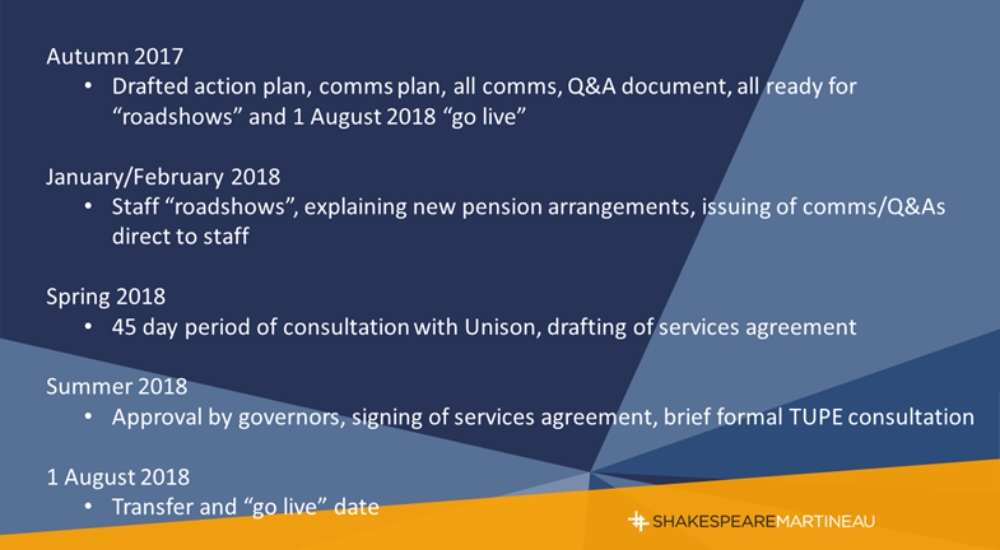
Tom explained that the TUPE consultation itself was brief, lasting only a few weeks, as they had already gone through extensive collective consultation with Unison in order to draft the services agreement, and had therefore already covered much of the same ground.
What’s Happened Since?
- The University have made considerable savings and are much better placed to secure their financial sustainability.
- This has had no impact on recruitment / retention. They have reviewed and monitored this regularly.
- The subsidiary company is managed centrally in the same way that university employees are managed. The same policies and all other T&Cs apply across all staff, so there are no significant additional management costs.
- They now also employ new academic staff through the subsidiary company.
- There have been a couple of brief periods of Industrial Action.
On the subject of Industrial Action that has happened since, Tom shared that the move in 2018 went remarkably smoothly and whilst Unison provided robust feedback as part of the consultation, as might be expected, there was no industrial action.
The move to appoint teaching staff into the subsidiary company has triggered a response from UCU. It is understandable that UCU may worry that that this latest move may signal the death knell for the right to access the TPS for their members, and therefore they have triggered some industrial action in protest of this, and although it has had little practical impact to date. Clearly the University continue to manage their industrial relations carefully whilst also trying to ensure financial sustainability and safeguarding the future of the institution.
Further contacts:
Tom Long: (2) Tom Long | LinkedIn