
In September 2023, Debra French, Organisational Development and Engagement Manager in Nottingham college came along to our Breakfast Club in September to share the sector leading work they have been doing linked to Mental Health and Wellbeing, endorsed by the team scooping up the prestigious AoC Beacon Award for Mental Health and Wellbeing Support. They were thrilled to win, especially as they hadn’t put in an application for an award for over 10 years.
Context
Nottingham College is large General Further Education College, in the Top 10 of FE colleges in the UK, with 8 sites and around 1500 colleagues, split broadly 50-50 between teaching staff and professional services staff.
Embarking on implementing a Wellbeing Strategy was a huge challenge for them given the size of the college. They started out by reflecting on the dictionary definition of Wellbeing: “The State of Being Comfortable, Health and Happy”! This was an important definition to come back to as they recognised there were so many different components that would need to be worked on in order to ensure that the state of being ‘happy’ flowed through the entire employee life cycle.
One of the key things for them as a college, given the size of the college and the challenge ahead of them was to share the marginal gains along the way to help build and sustain momentum.
Their mantra was “Future Ready” – and they would talk about the “Thrive Factor” – this came about as it was the name that staff came up with for their new HR and Payroll System, that went live on 1st April 23. They asked about the “Thrive” factor to try to establish what it truly meant to staff. They wanted to be clear about how they were going to deliver their commitment to wellbeing, which sat at the heart of the “Thrive” factor.
Their Workplace Wellbeing Package is much wider that ensuring the right wrap around support for colleagues, it goes deep and further. It’s all about:
- Realistic workloads
- Clarity of role, responsibilities and boundaries
- Feelings of value and appreciation
- Living the vision, values and purpose (5 years ago, they had been through a merger – they have refreshed their mission, vision and values and consulted widely on it).
- Capable leadership and management – have invested a lot in leadership.
- Concise and comprehensible communication – they have heavily focused on precise communication.
They started their journey looking at and considering all of the different elements of Debra Corey’s Wellbeing Bridge
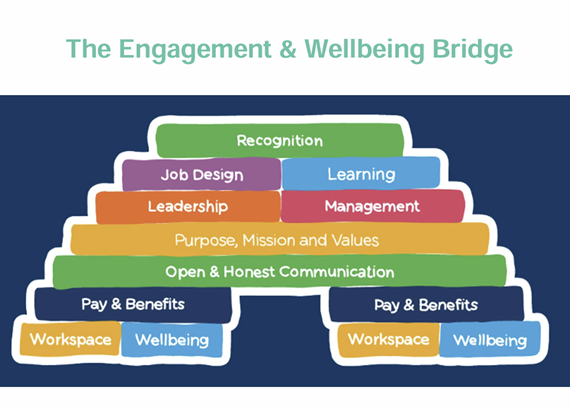
They started looking at workspace – particularly after the pandemic, how could they create spaces that could enable people to be at their best.
The whole narrative around pay and benefits was also a huge factor, especially given the pressure on the sector to match the 6.5% pay offer to school teachers.
They focussed heavily on listening and engaging with colleagues more than ever before.
Their new CEO, Janet Smith had joined the college a year before and a new strategic plan was put in place to provide the strategic direction, together with a new Mission, Vision and Values.
They focussed on Leadership and Job Design and also on appreciation, recognising and appreciating their colleagues.
They developed a People Strategy, which has now been n place for a year. The consulted with over 100 leaders on their People Strategy and what they needed to achieve. Out of this came 10 strategic areas that they needed to focus on.
And for them Wellbeing, that ‘being happy’ flows through all of these touch-stones.
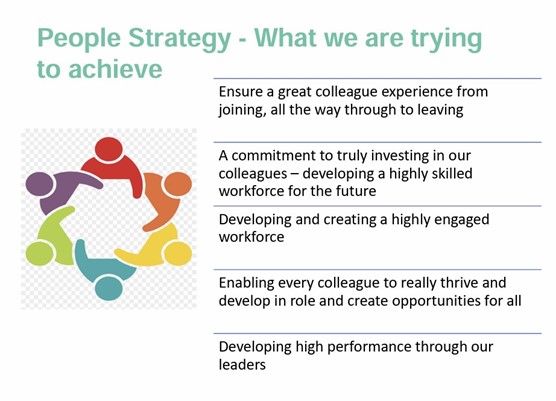
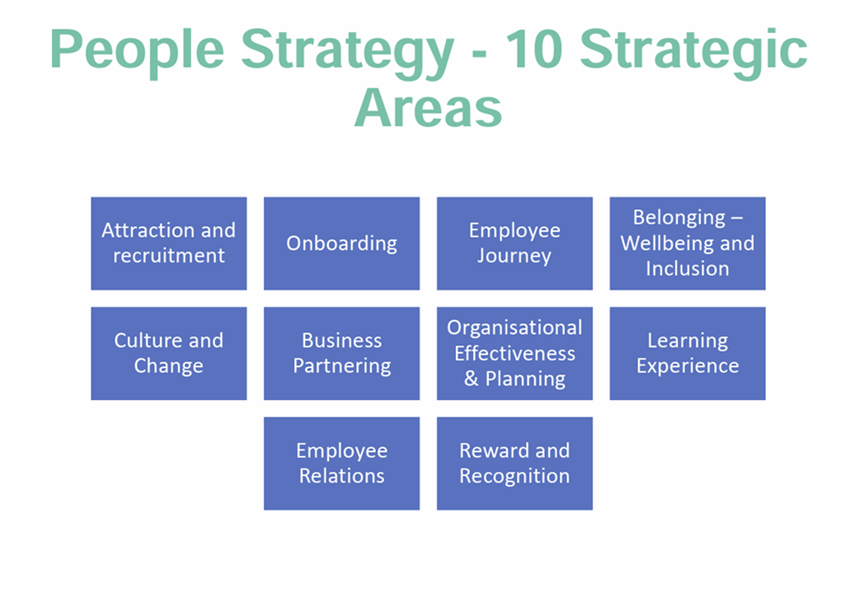
The 10 strands of the People Strategy were also touchstones that were part of the Wellbeing Bridge.
Debra explained that they have undergone huge changes as a result of the merger between which took place of Central College Nottingham and New College Nottingham in 2017.
So what did they do?
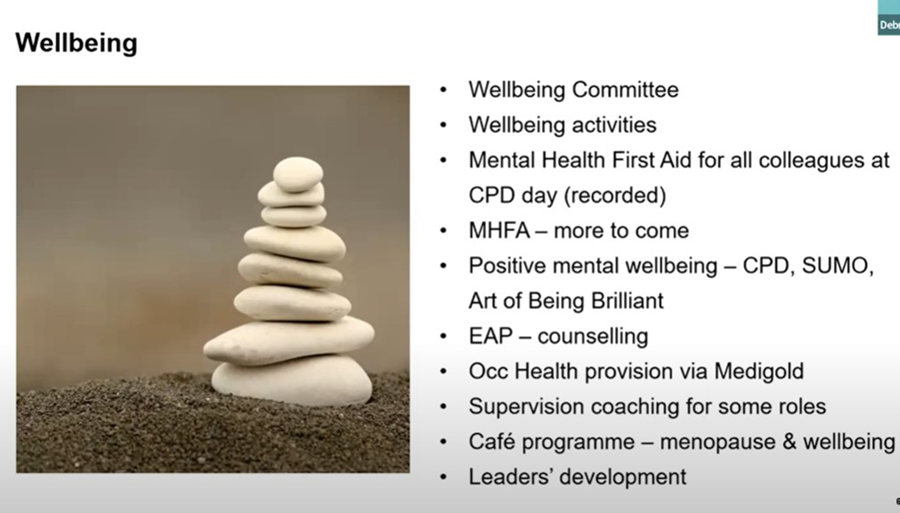
They introduced a Wellbeing Committee, and a team of over 50 Change Champions to help disseminate their messages around wellbeing. This was originally to help them to roll out “Thrive” (The HR System). These are not managers, but team members spanning every team across the organisation. They meet every fortnight for a maximum of 45 minutes on a Monday. They get key messages out through these champions and these are brilliant at spreading the word at a local level across their respective teams. It really helped them to supplement other communication methods, such as the staff intranet and social media. Through corridor conversations and through team meetings, the change champions supported them in rolling out and embedding Thrive. They provided updates, shared news. But the role of the change champions and the wider group continued to be active beyond the launch of the HR system, and they continue to help to push out messages relating to the people strategy including all the wellbeing activities.
They have introduced and trained a network of 26 Mental Health First Aiders whose focus is to support staff. They undertook the Mental Health First Aid Qualification with Mental Health First Aid England. This qualification is specifically with a focus on MHFA for adults. Debra herself is doing the Train the Trainer course in November to be able to deliver (as it’s very expensive to send staff on this course). Their aim is to deliver it in-house to more than a hundred colleagues.
In their CPD days they also covered stuff around Positive Mental Wellbeing and being ‘up-stream’, rather than ‘down-stream’. In particular Debra recommended S.U.M.O Guy, (Professor Paul McGee), and his book “Shut Up and Move On”. Also, Andy Cope, came in to do a key note on a CPD day. (The Art of Being Brilliant). He has a doctorate in happiness!! He keeps it real, he’s funny and went down very well indeed and she recommended thinking about bringing him in to engage with staff.
EAP / Counselling offering – they learned that they need to consistently communicate on this to staff. People forget that it’s not just there for them, but also for members of their household.
They work with Medigold for their Occupational Health services and they have supervision coaching for some roles. Recently through “Education Support”, who were offering free supervision for Senior Leaders, they have accessed this support for their senior leaders -and it’s all FREE!
Their Café Programme is also a key pillar of their approach to health and wellbeing and is covered in detail later in the case study.
Inclusion:
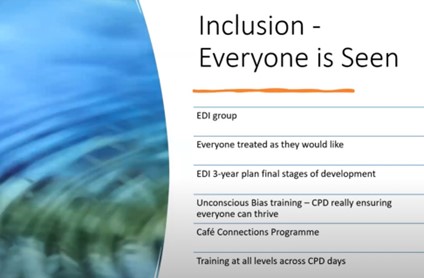
Debra outlined the range of structures in place to support Inclusion, including as most colleges have an EDI Group & Champions, and a 3 year EDI Action Plan. They have Unconscious Bias Training for Leaders but they also have unconscious bias training on their Learning Management System. They work with an organisation called Abintegro, a new LMS they procured at the beginning of 2023. Those packages have really helped them to roll out Learning and Development across a wide range of different areas.
Recognition
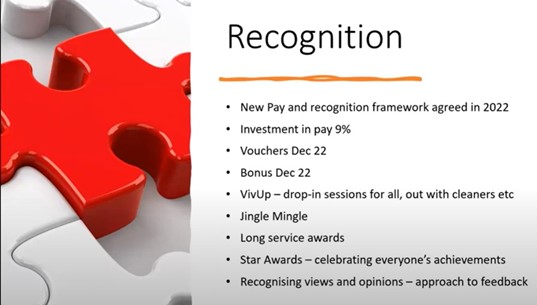
In 2022, they introduced a new pay and recognition framework.
For 10 years, there had been no pay rise in Nottingham College. So they made a huge investment.
They hadn’t even had a Christmas Do for quite some time, but they did introduce a ‘Jingle Mingle’. 2.00 pm to 6.00 pm last year. It was really great occasion. They gave people an envelope and asked them not to open it until 3.00 pm. Inside the envelope was news that they had a bonus of up to £250.00 and inside each envelope was a £50.00 love to shop voucher. It was quite emotional for some people, especially those who had worked at the college for a very long time and had never had a bonus. Janet Smith, CEO gave a speech. They’d had their Ofsted Inspection just before Christmas. It came a bit earlier than they were expecting. They had progressed from “Requiring Improvement” to “Good”, and naturally they were thrilled. The bonus and the jingle mingle was in appreciation of the effort staff had put in to help achieve this inspection outcome.
They also introduced Vivup – around the financial wellbeing piece, it’s free for public sector employees and in Debra’s words “It’s a must”.
Long service awards, they make it a really special event. They really make it a big deal, doing a citation of the individual’s career with them. They have messages read out from colleagues and they live stream to all other colleagues across the college.
Star Awards – a similar thing, staff and students nominate, and they do a big reveal in their theatre. People love it. They had over 800 nominations showing appreciation for colleagues.
Recognising views and options: they have a lot of feedback mechanisms. They listen to what people say. They used to run their Employee Engagement survey in house, but as part of the People Strategy, they have decided to invest in an external system, and they’ve chosen to partner with Best Companies. https://www.b.co.uk
Their contract is due to be reviewed in November and they will renew. They’ve very happy with them. They’re not the cheapest but they’ve very pleased with what they’ve seen. They did their first 8 factor survey last year. They do a lot of work with them and also do a pulse survey. They are also doing a “You Said We Did” session before they launch the next survey. There are 8 factors that they are assessed against.
We Love a Badge!!
They love a badge in Nottingham College. Those who have won a star award, have a pin badge and a coffee cup. They really love them and people do wear them with pride and often contact Debra for a replacement badge if they’ve lost them. They mean a lot to them. They also give a pin badge and nicely packaged gift cards to those who have long service awards.


Purpose, Mission, Values and Communication
Their new CEO Janet joined them on 1st July 2022. In the October they went to Notts County Football Ground and ran lots of sessions where groups of staff helped to develop their new Mission, Vision and Values. People felt really engaged with this.
They came up with their new mission “We unlock potential through learning.” The mission was not just great for students, but it also aligned well for staff as part of their employer brand and value proposition.
In the pulse survey they did in July 23 the % increase of responses for the statement that people really understood and engaged with the Mission, Vision and values was huge, reinforcing that staff had really engaged with the process of inputting to and refreshing the College’s Mission, Vision and Value.
In their Employee Engagement Survey “Be Heard”, conducted last year, they had a response rate of 68%. Debra said she was disappointed about this, as she didn’t hit her target of 80%! The factor she believed had an impact on achieving the target was the fact that Ofsted came in earlier than expected and two surveys were held in quick succession, with theirs taking place after the Ofsted one, giving them a little less time to promote it and get their message out. Their target of 80% remains firmly in their sights however for the next survey! They had 959 responses out of around 1500 employees. Through Best Companies, you can make a donation, and so for every single employee that took part in the survey the College donated £2.00. Raising £1918.00 in total. The money went to the Trussell Trust, which is for Food Banks across the UK. This year they’ll be going out to ask staff who they would like the donation to go out to.
8 factors from Best Companies – one factor is Giving Back – they thought they would do well on this factor. But the section on supporting their local community turned out to be one of the lowest scores. They had a clear message that they needed to do more around ‘giving back’ in terms of social action locally. Subsequently, this is an area they’ve really focussed on.
They’ve got heavily involved in Good For Me, Good for FE. This offers up colleges the chance to also put themselves up for an award. There are a whole range of award categories for students and staff. This was a great catalyst, as on the back of the survey, knowing what staff wanted i.e. to be able to do some volunteering. Their Executive Leadership Team asked Debra to explore, what it could look like , for a whole college approach using one of two summer CPD days that are close together for staff to take part in volunteering, fund-raising or social action. These are the ‘marginal gains’ that help people to thrive. It also helps to move them in terms of sustainability.
Leadership Development & Learning
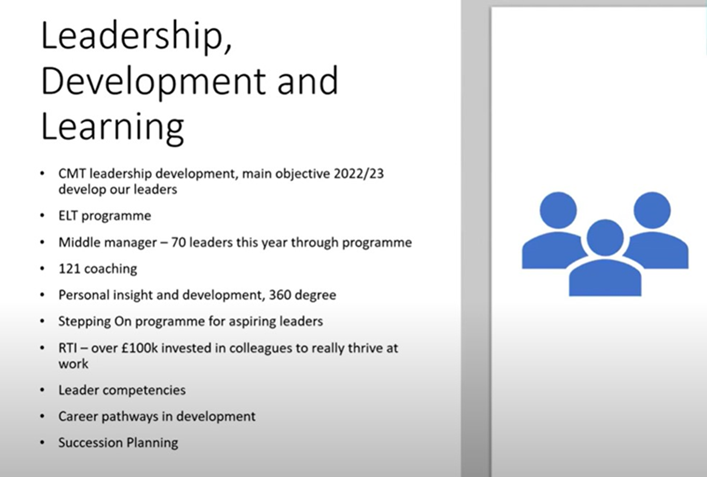
The have undertaken a huge amount of work to train their leaders.
From their Exec Leadership Team to the College Management Team (Senior Leadership Team), and over 70 middle managers. They have created 50 new roles for curriculum managers. And this year, the are working through a new programme for first line managers, which is predominantly delivered in-house. They also have a programme for aspiring leaders (Stepping on programme) which they partner with the Skills and Education Group. 66% of last year’s cohort have already progressed into leadership roles.
Benefits
To help support financial wellbeing, the VIVUP scheme, which is completely free puts real benefits into the pockets of staff. Debra explained that from her pay, she’ll take a chunk from her wages and investing it into the Sainsbury card and will place what she thinks she’ll spend that month, and knows she’ll get 5% off her monthly shop. With the Morrisons’s card it also covers fuel. She highly recommended it. Their staff absolutely love it. The range of offers is fantastic from many retailers and across a wide range of products and services.
Wellbeing Walk and Talks
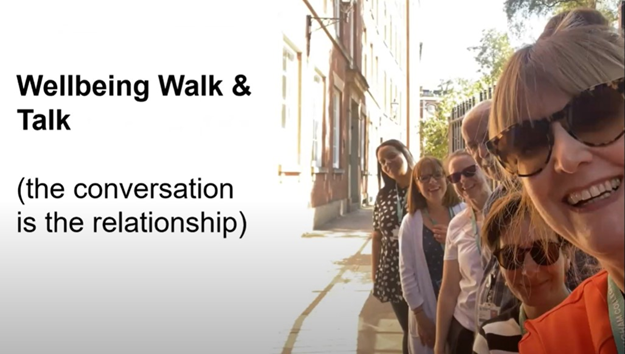
They host wellbeing talks as part of their onboarding process. It’s a great way to meet staff from across other sites. They take place at lunch time, across all of their 8 different sites.
The Café Connections Programme
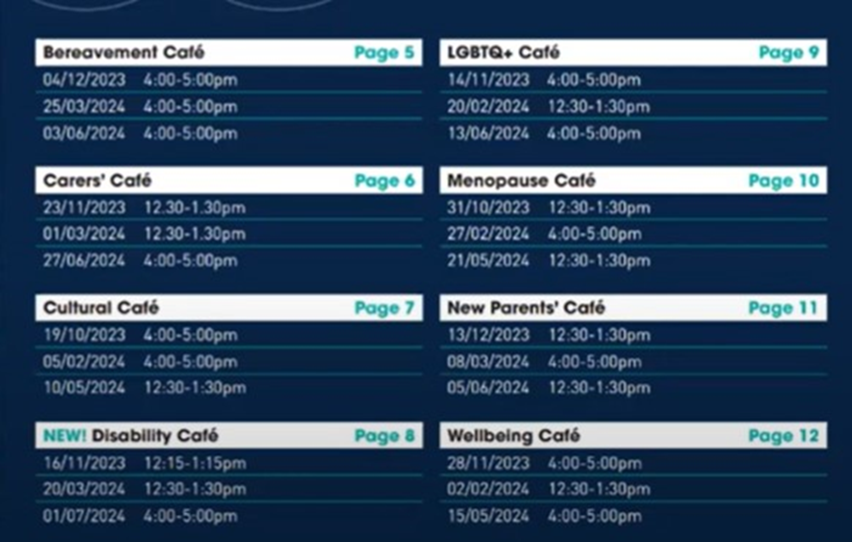
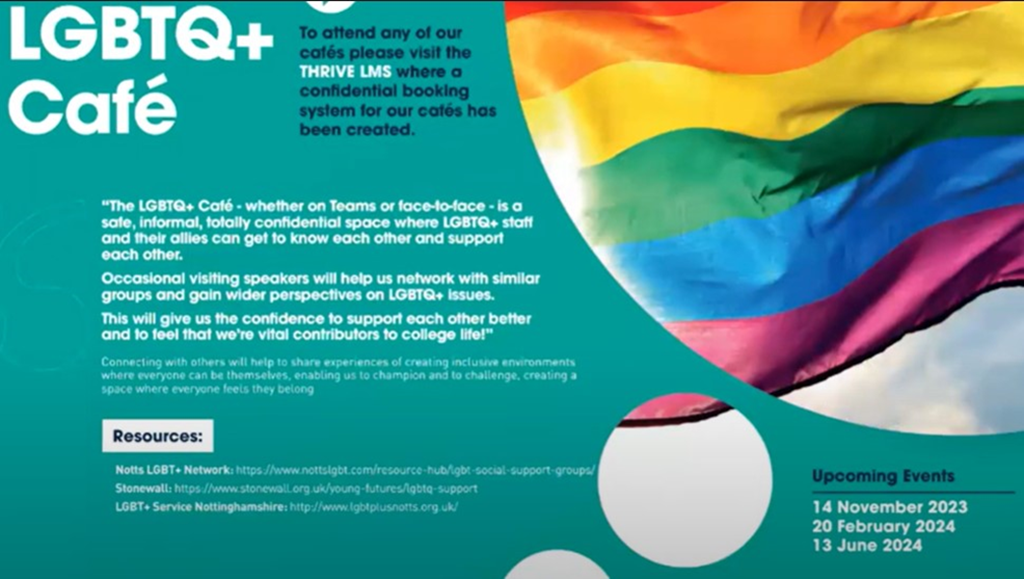
This has made a big difference for them and in Debra’s view this was the USP for being a beacon award winner, as what set them apart was the support and activities that they have available for staff, as well as students. It came from an idea a few years ago, when some people couldn’t come to their long service awards. 5 people couldn’t attend because they were carers. Debra realised if 5 people from that group of staff couldn’t attend, that there was potentially a large proportion of staff who were carers (up to 300). So they started off with a Carers Café. The take up was immense (this was pre-Covid). There were so many carers who at the time they thought they had been “hiding in plain sight” but now they realise that they weren’t, they simply weren’t looking for them. They quickly also sent up a Menopause Café. 63% women in the college, of which 33% are in the age demographic 45+. Their ambition is to be the last generation to sleepwalk into the menopause. They now have 8 different cafes running on a termly basis. The staff themselves choose the name for the Café.
They have a nice glossy brochure for each of the Café groups. They are published on their staff intranet. They have guest speakers in all of their Cafes/ People can book confidentially through the college LMS system. This is important as in some cases they are linked to protected characteristics.
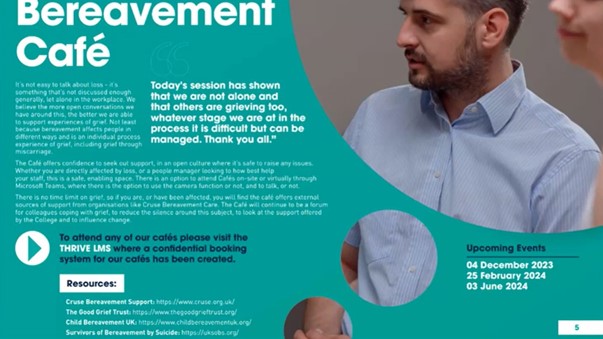
Bereavement Café
When they first launched the Bereavement Café, it was clear it was such a ‘taboo’ subject, and there were some staff strong presence from men who have suffered bereavement. Some were sharing the same office and didn’t know that each other had experienced bereavement. Colleagues helped them to develop guidance for leaders around bereavement.
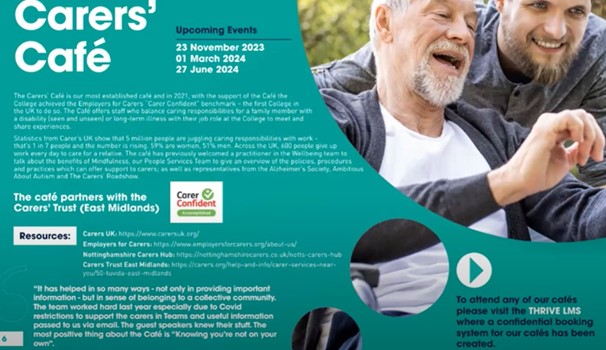
Carer’s Café
They were the first college to gain a Carer Confident Kitemark. The value proposition of this is evident through recruitment, attraction and retention. They know the kitemark has been a differentiator for staff joining Nottingham College rather than other employers.
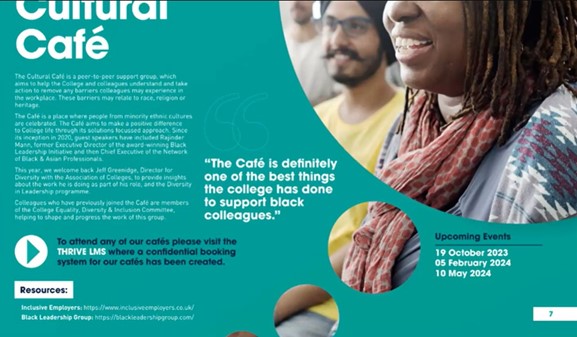
The name of the Cultural Café, has evolved from the original BAME title. Group members were not happy with the BAME title and it is now known as the Cultural Café. They have had lots of speakers including Jeff Greenidge from the AoC.
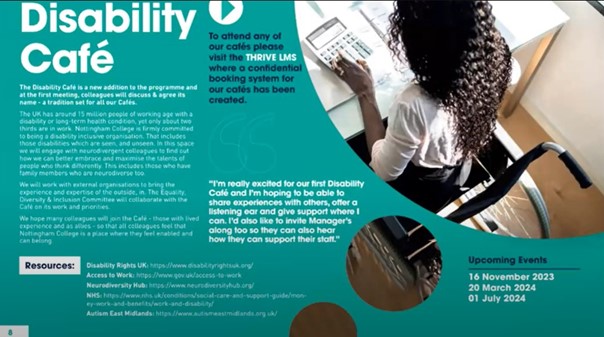
The Disability Café is for both seen and unseen disabilities. This Café group has now highlighted how many colleagues are neurodiverse, at all levels or the organisation. They have many colleagues who are neurodiverse. They describe it as their “superpower”. They have guest speakers for this group too. They are developing case studies from staff who are speaking up about neurodiversity to share as part of their activities during inclusion week to help shine a light on neurodiversity.
The Menopause Café
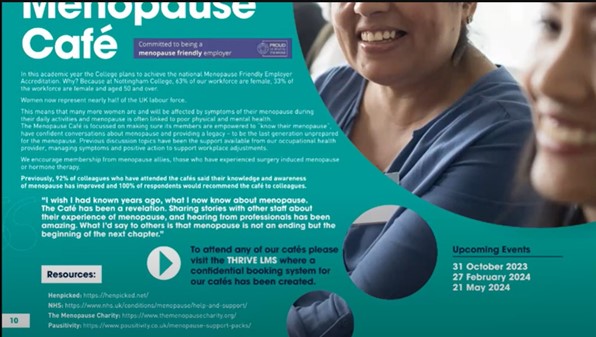
They work with Hen-Picked, (Founder: Deborah Garlick) – they’re on the journey, committed to becoming a Menopause Friendly Employer. They do training for all their leaders. They also welcome men into this Café who are keen to know what they can do to support colleagues, and also some men, some of whom may have been tipped inot menoapuse through medical treatment. They know it’s very expensive to go to see a consultant. They have brought in two well recognised specialists to talk about Menopause, one who is local and also Dr. Shahazadi Harper who has a clinic the Harper Clinic in Harley Street. They do Q&A sessions, collating the questions beforehand.
The Wellbeing Café
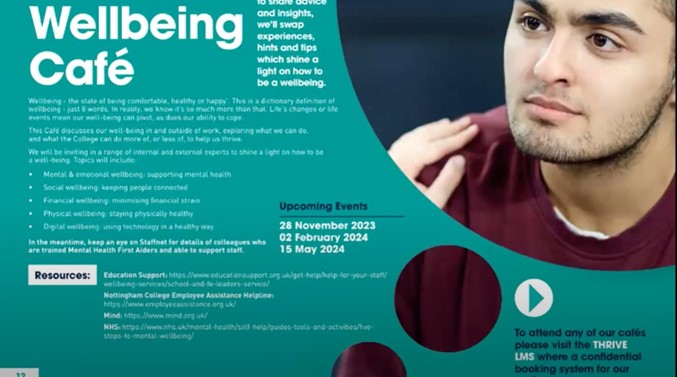
Their first café is all about Men, it’ll take place on International Men’s Day. Deborah is open to talk to members of the FE HR Hub Community. She’s also keen to hear from other colleges on what they are doing.
Questions & Answer Session
Q. How do you get best value out of these groups? How to structure them so there’s more value and information coming from them?
A. Some of them are colleague led. Some colleagues may be keen to take on and lead sessions. They research guest speakers.
Senior level sponsorship is really valuable. heir Deputy CEO, Janet Smith will be attending the first Disability café.
It’s fully embedded through their whole way of working. E.g. When business partners are discussing returns-to-work – they signpost to the cafes. For those experiencing bereavement, manager had signposted the Bereavement Café. It has to flow through what you do. When staff go on Maternity / Paternity Leave, they write to them to let them know. E.g. Menopause café, in a college you will have people that you can harness to add value in that session, e.g. hair and beauty, colleagues who lecture on nutrition. Debra recommended looking at what talent they have in house. They had somebody who was trained in Makaton, so invited them to speak at the New Parents group. Last year they had 6 sessions for every café, but it turned out to be too much. They may also do stuff on CPD days. She recommended that it’s around getting the messaging to the Senior Leadership Team. The benefits are huge. When they re-write policies e.g. flexible working policy – they included people from the Carers’ group. Annual certification – you pay once for your HRT certificates. She’s paid £12.00 for the year- all about financial wellbeing. Harness the power of those in your cafes.
Q. Do you register as an organisation for VIVUP?
A. They registered as an organisation. They don’t have an API link. To set up it up they did a bulk upload of staff names and contact details. Every month they do a new upload of new starters and promote it heavily at their corporate induction session.
Q. Are there still paid modules of VIVUP?
A. No they don’t use any of their paid modules. They did extensive research on the various discount schemes, but it was VIVUP that came to their attention because of the discounts with the supermarkets.
Q. Do you get feedback from staff on VIVUP?
A. Yes – they get feedback on what it is that staff are focusing on. How many and what they’re looking at.
Q. How do you recommend boosting interest in these types of groups?
A. New for this year, we’re going around every campus and do the blended thing – people can join remotely, they’ve going to take a blended approach, where people can either join remotely or in person. Not everyone is comfortable even having their camera on for example in the Bereavement Cafe. They run a lot of their cafes between 4.00 and 5.00pm. They deliberately run them at the end of the day, so people can go home afterwards. How they communicate is really important. For example, they would never email somebody about the Bereavement Group. They would send a letter to their home address to let them know about it.
Useful links / further reading:
Employee Benefits Platform Focus On Employee Engagement | Vivup (vivupbenefits.co.uk)