
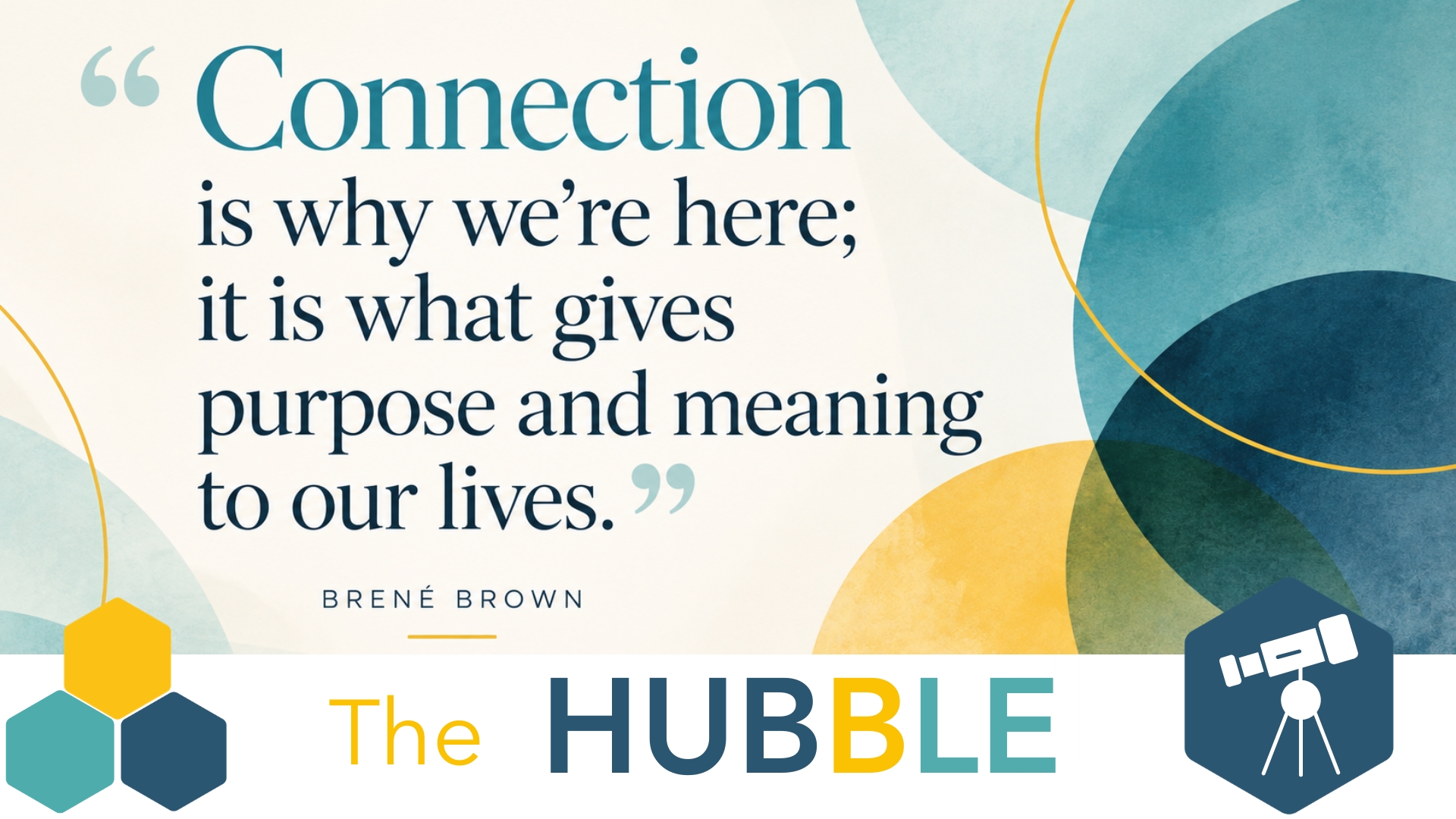
Beyond Networking: Why Connection is Becoming a Leadership Essential
Five small ways to build stronger professional relationships – for ourselves, our teams and our organisations.
I’ve spent quite a bit of time over recent months talking with FE leaders and People professionals about the challenges they’re navigating, the support they need and what the future of our profession might look like.
Last week’s AoC conference brought many of those conversations together for me.
It was a wonderful opportunity to reconnect with familiar faces, meet people I’d previously only known through a screen, and make new connections along the way.
I also had some genuinely uplifting conversations about what we’re building at FE HR Hub. The warmth, encouragement and interest were palpable. People were curious about where we’re heading, enthusiastic about what we’re doing and keen to find out more.
It was enormously encouraging. But what stayed with me wasn’t simply the positive feedback. It was the sense of shared purpose that emerged through those conversations. People recognised the value of having somewhere to connect with others who understand their world, exchange ideas, learn from different perspectives and feel part of something beyond their own organisation.
And throughout the conference, that same theme kept resurfacing.
More than just networking
Faye McGuinness spoke about the importance of community in supporting wellbeing, particularly the value of having people with whom we can share not only what we’re experiencing, but how we’re feeling.
Later, during a session exploring how we support aspiring and newly appointed leaders, we heard how those who felt connected with others as they navigated their leadership journey tended to have a much more positive experience.
Different conversations, different contexts, but a remarkably consistent message.
It made me reflect on how easily we can underestimate the role that professional relationships play in our effectiveness, confidence and wellbeing.
We tend to think of networking as something we do to broaden our contacts, develop our careers or perhaps open doors to new opportunities. All perfectly valid reasons.
But meaningful professional connection offers something much more valuable.
It gives us access to perspectives we might not otherwise encounter. It creates opportunities to test our thinking, learn from others’ experiences and recognise that the challenges we’re facing aren’t necessarily unique to us.
And sometimes, particularly when things are difficult, it simply reminds us that we’re not navigating everything alone.
Connection and the realities of FE leadership
Working in Further Education brings particular challenges.
Our colleges are complex organisations operating in an environment of constant change, competing priorities and considerable external scrutiny. The demands on leaders and People professionals are significant, and the pace rarely seems to ease.
For those working in HR, there can be an additional dimension. We’re often the people others turn to when something is difficult, sensitive or uncertain. We’re expected to provide perspective, offer reassurance and help find a way forward.
But where do we go when we need those things ourselves?
Even within a supportive organisation, there are occasions when it helps to speak with someone outside it. Someone who understands the context, but isn’t caught up in the same circumstances.
That’s one of the things I’ve valued most about the conversations we’ve had through FE HR Hub over the years. There is something incredibly reassuring about hearing someone describe a challenge and realising that others are grappling with precisely the same issue.
Not because it makes the problem disappear, but because sharing experiences can help us approach it differently.
Professional connection shouldn’t be regarded as an optional extra, squeezed in when everything else has been dealt with. It can be an important part of how we develop capability, sustain resilience and become better at what we do.
Making connection more intentional
Of course, recognising the value of connection and actually making time for it are two different things.
We’re all familiar with the pressures of the working week. The diary fills, priorities shift and the conversation we’ve been meaning to have gets pushed back yet again.
So perhaps the question isn’t whether connection matters, but how we become more intentional about creating it.
Here are five small things worth considering.
1. Protect time for conversations that don’t have an immediate agenda
We make time for operational meetings, performance reviews and project updates because we recognise their importance.
But how often do we make the same commitment to maintaining our professional relationships?
Consider protecting half an hour every fortnight to catch up with someone outside your immediate team or organisation. It doesn’t need to be about solving a particular problem. Sometimes the most valuable insights emerge from conversations that aren’t driven by an agenda.
2. Ask how someone is finding things, not just how things are going
One of the messages I took from Faye McGuinness’s contribution was the importance of creating opportunities for people to share how they’re feeling, not simply what they’re doing.
There’s a subtle but important difference between asking someone, “How are things going?” and “How are you finding things at the moment?”
The first often prompts an operational update. The second may open the door to a more meaningful conversation.
Of course, asking the question is only part of it. We also need to be prepared to listen, without immediately trying to fix whatever comes next.
3. Making introductions to help others grow
As leaders, one of the most valuable things we can do is connect people with others who might help them develop.
Think about a newly appointed manager, an aspiring leader or an HR colleague taking on an unfamiliar responsibility.
Is there someone in your professional network who has navigated something similar? Someone who could offer encouragement, share their experience or simply provide another perspective?
Making that introduction takes very little time, but its value can extend well beyond the initial conversation.
4. Turn individual learning into shared learning
Professional development is often treated as an individual activity. Someone attends a conference, joins a webinar or completes a programme, and we hope that the benefits somehow find their way back into the organisation.
What if we were more deliberate about making learning a shared experience?
After attending an external event, bring colleagues together to discuss what stood out. Not simply to report back on the content, but to explore what it might mean for your organisation.
One of my favourite questions is: What have we heard that challenges the way we currently do things?
It’s a simple way of turning connection with the wider profession into an opportunity for organisational learning.
5. Reconnect with someone you’ve lost touch with
We all have former colleagues, mentors and professional contacts who have made a difference to us along the way.
And yet, despite our best intentions, those relationships can gradually drift as careers and circumstances change.
Why not reach out to someone you’ve been meaning to contact?
Not because you need something from them, or because there’s a particular opportunity to pursue. Simply because you value the connection.
Some of the most rewarding conversations I’ve had recently have been with people I haven’t seen for years, alongside others I’d previously only met online.
It’s reminded me that relationships don’t necessarily need constant attention, but they do benefit from a little intention.
Connection is a leadership responsibility too
There is, however, a wider point here.
We shouldn’t place the entire responsibility for building connection on individuals.
Leaders and organisations have an important role in creating the conditions where meaningful professional relationships can develop.
That might mean giving colleagues time to participate in professional communities, encouraging cross-college collaboration, creating opportunities for emerging leaders to learn from experienced colleagues, or recognising that informal conversations can be just as valuable as formal development.
One of the most encouraging aspects of launching our FE HR Hub Founder Membership has been seeing senior leaders make that commitment so visibly.
Those Principals and senior leaders who have embraced the opportunity to become Founder Members have done more than recognise the value of professional connection. They’ve made a deliberate decision to invest in it, creating the conditions for their People teams to participate in a wider professional community, share experiences and develop alongside colleagues from across the sector.
And there’s something particularly powerful about that visible commitment.
It sends a clear message to HR colleagues that connecting with their professional community isn’t something they need to squeeze into the margins of an already busy working week, or feel obliged to justify every time an opportunity arises. It has the backing of their senior leadership team. They have the confidence and permission to engage, knowing that their organisation recognises the value of doing so.
For me, that’s leadership in action.
|Not simply encouraging people to develop and connect, but making it easier for them to do so.
And it raises a wider question for all of us in leadership roles. Are we genuinely creating the time, space and permission for our people to build professional relationships, or are we simply encouraging them to do so while leaving all the usual pressures unchanged?
If every moment of the working day is consumed by immediate operational priorities, it’s hardly surprising that building relationships and sharing learning fall to the bottom of the list.
Yet those are often the very activities that help us become more effective, avoid reinventing the wheel and find better ways of working.
Perhaps we need to stop seeing connection as something we do when we have time, and start recognising it as part of how we do our jobs well.
Building something together
Over the summer, I’ve been reflecting a great deal on what the next chapter of FE HR Hub should look like.
The conversations I’ve had with People professionals and college leaders have reinforced something I’ve believed for a long time: there is enormous value in bringing people together around shared challenges, experiences and ambitions.
It’s why community has always been central to FE HR Hub, and why we’re now developing opportunities for colleges to connect, share expertise and support one another in a more sustained way.
The response to our plans has meant so much to me, not simply because people have welcomed what we’re doing, but because it has reinforced the appetite for a professional community that helps individuals and organisations grow.
And I think that’s something worth nurturing.
Because the value of a professional network isn’t simply measured by how many people we know. It’s reflected in the quality of the relationships we build, what we learn from one another and what we’re able to achieve together.
One connection. One conversation. One small action
So here’s a thought to take into the coming week.
Reach out to someone you’ve been meaning to speak to. Introduce two colleagues who could learn from one another. Make time for a conversation that isn’t dominated by the next urgent task.
Or perhaps ask yourself whether the people you lead have the same opportunities to build meaningful professional relationships that you’ve benefited from throughout your own career.
It doesn’t need to be complicated. But it does need to be intentional.
And I’d love to hear your thoughts.
What’s one professional connection that’s made a real difference to your career — and what did it give you that formal development couldn’t?
Connect. Share.Grow.Together.
FE HR Hub – supporting the people who support Further Education